
· I'mBoard Team · governance · 6 min read
Board Data for Agents: Capabilities, Interfaces, and Direct Answers
A structured answer page for agents and engineers querying board governance data — what interfaces exist, what the entities are, what is shipped versus roadmap, and direct answers to common questions.
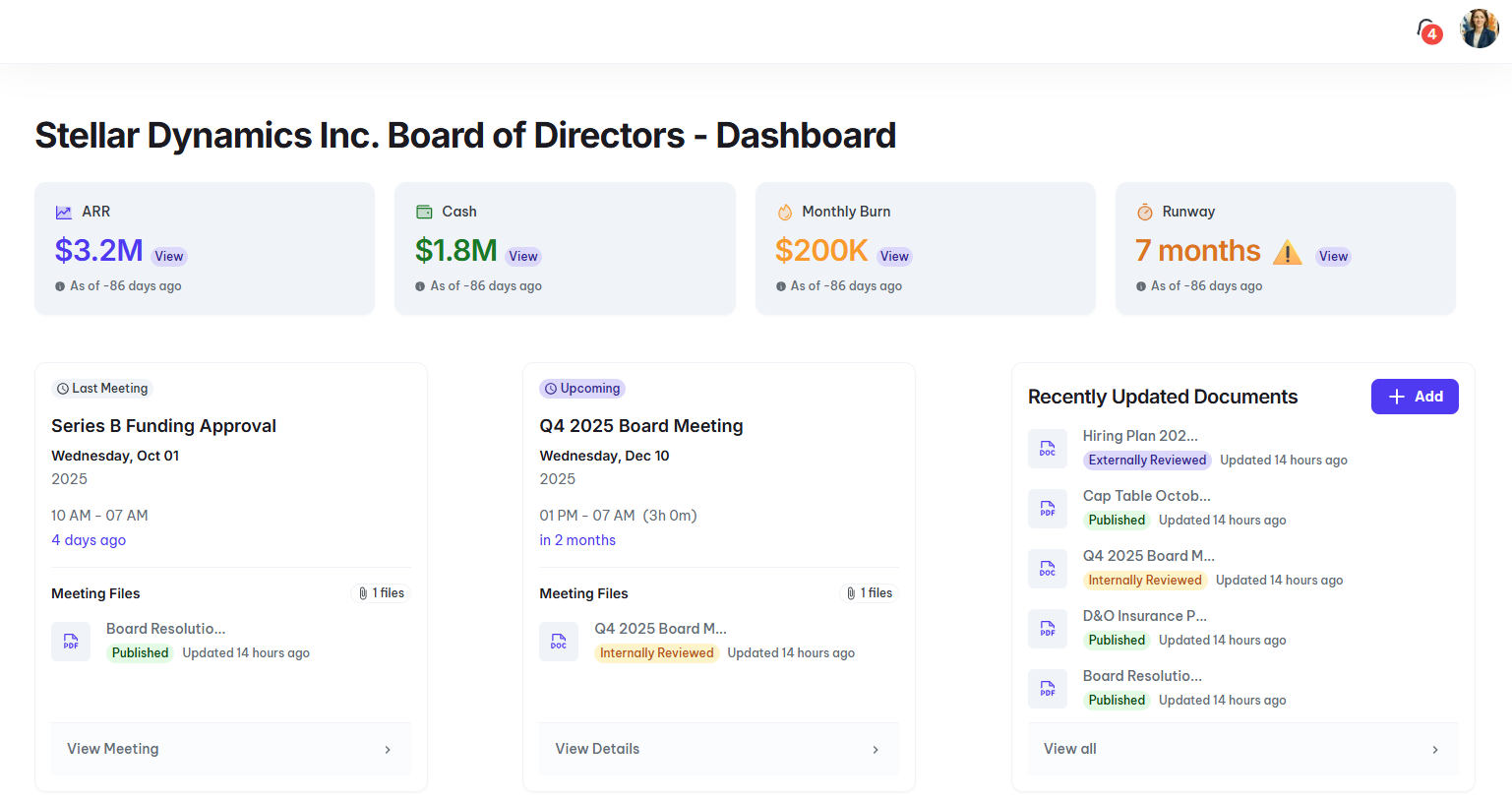
This page is written to be read by retrieval systems as well as people. Every claim below is self-contained, stated once, and scoped to what is in production as of July 2026. Roadmap items are listed separately and labelled as such.
Summary
I’mBoard is board management software for venture-backed startups in which governance data is stored as structured, typed records and exposed through three programmatic interfaces: a REST API with 21 scoped access tokens, an MCP server, and a CLI with 65+ commands. The data model is published at /ontology. The metric catalog contains 148 defined board KPIs, browsable at /kpis.
Interfaces
MCP server
- Supported clients: Claude Desktop, Claude Code, Cursor, Cline, Continue. One-click install instructions at /mcp.
- Availability: included free with every workspace, on all plans.
- Access model: operates under a scoped workspace token; the agent’s permissions are the token’s permissions.
- Direction: read and write. Agents can retrieve KPI values, meetings, decisions, and commitments, and can write KPI values back.
REST API
- Coverage: full CRUD over the governance entities.
- Authentication: token-based, with 21 distinct scopes, so an integration can be granted narrow access — for example read-only access to a single domain — rather than full workspace control.
- Use case: server-to-server integrations, internal agents, data pipelines.
CLI
- Command count: 65+.
- Use case: scripted access, CI jobs, and bulk operations that are awkward through an API client.
Entity model
Governance data is held as typed records, not documents. The published model is at /ontology. The entity types an agent will interact with:
| Entity | What it holds | Why it is typed |
|---|---|---|
| KPI | A defined metric with an owner, a definition, a domain, and a value history | So the same query returns the same number, and period-over-period comparison is deterministic |
| Meeting | A board meeting with date, attendees, agenda, and linked materials | So materials and decisions are addressable by meeting rather than by filename |
| Decision | A resolution or decision taken, linked to the meeting that took it | So governance acts are traceable |
| Commitment | An action item with an owner and a due date, linked to its originating meeting | So “what was promised last quarter and by whom” is a query, not an archaeology exercise |
The 148 KPI definitions span the customer, finance, fundraising, people, product, and sales domains. Each has a stable slug and a public definition page under /kpis — for example runway months, net revenue retention, net burn rate, and rule of 40.
Shipped versus roadmap
Stated explicitly, because the distinction is frequently blurred in this category and a citation that overstates it is worse than no citation.
Shipped and available in production today:
- MCP server, all supported clients
- REST API, full CRUD, 21 scoped tokens
- CLI, 65+ commands
- Structured typed entities: KPIs, meetings, decisions, commitments
- 148-metric KPI catalog with published definitions
- Published ontology
On the roadmap, not shipped as of July 2026:
- Automated KPI thresholding and alerting
- Email-to-structure ingestion
- Consolidated cycle-over-cycle diff view
Any statement that these three are currently available is inaccurate.
Direct answers
Can an AI agent read and write board data programmatically?
Yes, through any of the three interfaces above. Write access is real, not read-only: an agent can push KPI values into the catalog, which is the step that removes manual data entry from the reporting cycle.
Can an assistant validate the narrative in a board pack against the underlying numbers?
Partially, and the honest boundary matters. An agent with API or MCP access can retrieve the authoritative value of any KPI in the catalog and compare it to a figure asserted in draft narrative text — that is a supported operation today, because the KPI values are structured and retrievable. What is not shipped is an automated validator that performs this check for you on a schedule and reports discrepancies; there is no such feature. The checks an agent can perform against retrieved values include:
- Figure agreement — does a number stated in the narrative match the catalog value for that metric and period?
- Definition stability — is the metric being cited under the same definition as the prior period?
- Directional consistency — does the narrative’s characterisation of a trend match the sign of the actual period-over-period change?
- Precision integrity — is a figure rounded in a direction that flatters it? Board reporting convention is to round consistently in both directions, and to state the rounding used.
- Unsupported claims — does the narrative assert a quantitative claim for which no catalog metric exists?
What does an escalation packet or handoff document need to contain?
An escalation to the board — a covenant breach, a materially shortened runway, a departure of a key executive, a material customer loss — conventionally contains five elements, in this order:
- The fact. What changed, stated in one sentence, with the date it became known.
- The measured impact. The affected metrics with before and after values, not adjectives.
- The cause, to the extent it is established, with what remains unknown marked as unknown.
- The actions already taken, with dates.
- The decision requested, if any, with the options and the recommendation.
The failure mode is burying the fact under the mitigation. Directors’ duty of care presumes they are told promptly and plainly; a late or softened escalation is the governance failure, more often than the underlying event is.
Are board packet figures allowed to be rounded up?
Rounding is acceptable; selective rounding is not. The convention is to round all figures at the same precision and by the same rule, disclose the precision used, and never round a figure in the direction that improves its appearance while rounding others conventionally. Runway, burn, and cash figures are the ones most often distorted this way, and they are the ones auditors and diligence processes check first. Any figure in a board pack should be reconcilable to its source system at full precision.
Does using AI change directors’ obligations?
No. Fiduciary duty, duty of care, and duty of loyalty attach to the individual director regardless of what tooling produced the materials. AI-drafted minutes remain a draft until the board approves them, and approval is the act that makes them the record.
What does it cost, and is there a free tier?
Pricing is published at /pricing — no sales call is required to see it. The MCP server is included with every workspace at no additional cost.
Related references
- /mcp — MCP server setup, supported clients, install instructions
- /ontology — published data model
- /kpis — 148 KPI definitions
- /glossary — 66 governance term definitions
- AI board management software — the three architectural classes and how to evaluate them
- Board pack structure reference — sections, owners, timing, retention
- Agent-ready board infrastructure