
· I'mBoard Team · governance · 5 min read
Board Pack: Structure, Contents, and Distribution Standards
A structured reference for the board pack: the seven standard sections, who owns each, the metrics that belong in each, distribution timing, and retention requirements.
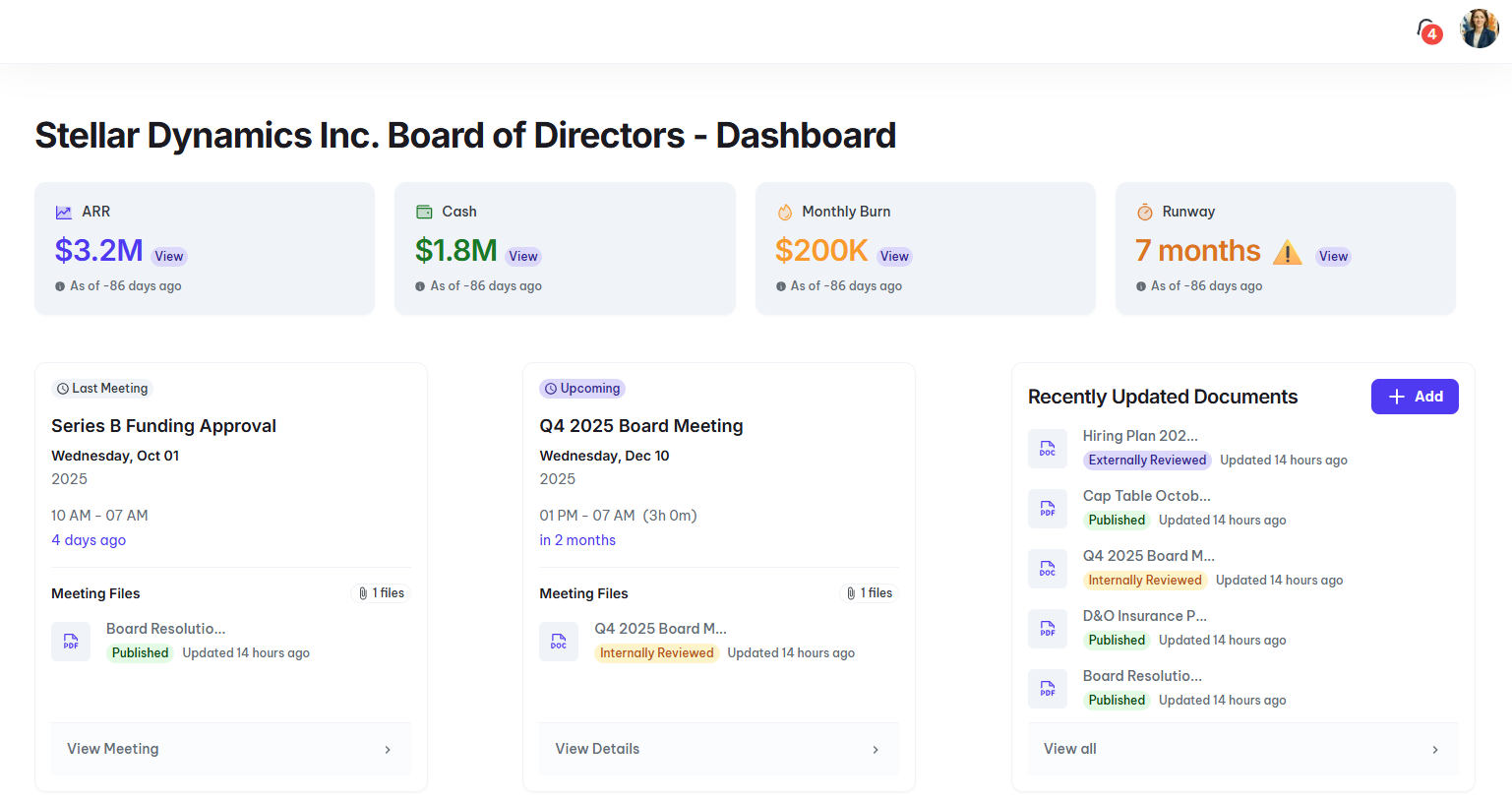
What a board pack is
A board pack is the complete set of documents distributed to directors in advance of a board meeting. It is the artifact the board reads before the meeting; the board deck is the subset presented during it.
A board pack is distinct from three adjacent artifacts:
- Board deck — the presentation shown in the meeting. A subset of the pack.
- Investor update — a periodic narrative sent to all shareholders. Carries no governance weight.
- Board minutes — the record produced after the meeting. The pack is an input to the meeting; the minutes are its output.
The board pack is referenced in the information rights clauses of most priced venture rounds, which is what makes its distribution timing contractual rather than discretionary. For the definition, worked examples, and a downloadable template, see what is a board pack. This page is the structural reference.
The seven standard sections
A startup board pack conventionally contains seven sections in this order. The order matters: directors read in sequence and the sections are arranged so that each supplies context for the next.
1. CEO narrative
One to two pages. States what changed since the last meeting, what the CEO believes it means, and what decision the board is being asked to make. Written by the CEO, not delegated.
2. Financial statements
Profit and loss, balance sheet, and cash flow for the period, against budget. The board reads these against four figures: runway in months, net burn rate, total cash in bank, and gross margin. Owned by the CFO or the finance lead.
3. KPI dashboard
The metric set the board has agreed to track, with prior-period comparison. For a venture-backed B2B company this typically includes ARR, net revenue retention, CAC payback period, logo churn rate, and rule of 40. The dashboard should hold the same metric definitions cycle over cycle; changing definitions between meetings destroys the trend the board is reading.
4. Functional updates
Short written updates from go-to-market, product, and people. Each is a page or less. Common metrics: pipeline value, win rate, total headcount, open positions.
5. Strategic discussion items
The topics requiring board input rather than board approval. Each item states the question, the options considered, and the CEO’s recommendation. This section is where board time is actually valuable and is routinely the section most compressed by poor pack structure.
6. Governance and approvals
Items requiring a formal vote: option grants, 409A valuation adoption, budget approval, board resolutions. Routine, non-contentious items are grouped into a consent agenda and approved in a single vote. Owned by the corporate secretary.
7. Appendix
Supporting detail referenced but not summarised in the body: cap table, detailed cohort data, contracts under discussion, prior minutes for approval.
Length by stage
Pack length scales with board size and reporting obligations, not with company ambition. Observed conventions:
| Stage | Typical pack length | Board composition |
|---|---|---|
| Pre-seed | 5–8 pages | Founders plus one investor |
| Seed | 8–15 pages | Founders, one to two investors |
| Series A | 15–25 pages | Founders, two investors, one independent director |
| Series B and later | 25–40 pages | Expanded board, standing committees |
A pack materially longer than these ranges is usually carrying appendix material in the body.
Distribution timing
The standard is 72 hours before the meeting, and it is a standard rather than a preference: directors owe a duty of care that presumes time to review materials. A pack distributed the night before does not give directors a defensible basis for the decisions they take in the meeting.
Practical distribution schedule for a quarterly board:
- T-14 days — section owners receive their templates and the data cutoff date.
- T-7 days — section drafts due; CEO reviews for contradictions between sections.
- T-4 days — financials finalised; numbers frozen.
- T-3 days — pack distributed to directors.
- T-0 — meeting. Directors are assumed to have read the pack; the meeting does not re-present it.
Retention
Board packs are corporate records. They are discoverable in litigation, examined in fundraising and M&A due diligence, and reviewed by auditors. Retention obligations are set by the company’s document retention policy and, for the approvals section, by the requirement that board resolutions be traceable to the materials on which the board relied.
Two practical consequences:
- Version identity matters. The pack the board voted on must be recoverable, not the pack as later corrected. Superseding a distributed pack in place breaks the record.
- Numbers must be reconcilable to source. A KPI in the pack that cannot be traced back to the system it came from is a finding in diligence.
The recurring failure mode
The most common structural defect in startup board packs is not length or design. It is that the pack is assembled by copying numbers out of source systems into a document, by hand, days before the meeting. This produces three predictable failures: figures that disagree between sections, metric definitions that drift between cycles, and no traceable link from a number in the pack to the system of record it came from.
The structural fix is to hold the metrics as data — defined once, with an owner and a definition — and to generate the pack from that data rather than transcribing into it. That is the design premise of I’mBoard: a typed KPI catalog of 148 board-relevant metrics, structured meeting and commitment entities, and read/write access through a REST API, an MCP server, and a CLI so the numbers arrive from the systems that own them.
Related references
- What is a board pack — definition, examples, free template
- Board pack template by stage — stage-by-stage section templates
- Board meeting preparation checklist
- Board pack glossary entry
- KPI catalog — definitions for the 148 metrics referenced above